China Top 10 LED Strip Light Suppliers How Energy Efficient?

Time:2026-09-19 Author:Henry
0%

LED strip lighting has moved from decorative accent use into retail, hospitality, signage, offices, and residential projects. That growth raises a practical question: how energy efficient are led strip lights when measured as complete systems, rather than attractive product claims?

The International Energy Agency reports that lighting represents roughly 15% of global electricity consumption. The U.S. Department of Energy also states that quality LED products can use at least 75% less energy than incandescent lighting. These figures are encouraging, but strip lights require closer inspection. A five-meter roll may consume 24 watts per meter, while another uses only 9.6 watts. Brightness, measured in lumens, matters as much as wattage. So does the power supply.

Efficiency is not only about the LED chip.

This article examines China’s top 10 LED strip light suppliers through measurable criteria, including luminous efficacy, input power, heat management, dimming performance, and product lifetime. It also considers evidence from LM-79 photometric testing, LM-80 LED lifetime testing, and ENERGY STAR guidance on LED performance. A reliable supplier should provide clear datasheets, consistent color temperature, and test documentation from recognized laboratories.

However, comparisons are not perfectly clean. Some manufacturers publish chip efficacy, while others report complete-strip performance after losses. That difference can mislead buyers. A strip glowing brightly on a showroom wall may still waste energy through an inefficient driver or poor aluminum profile.

The following review connects published industry data with practical purchasing experience. It asks not merely which suppliers rank highest, but which products deliver useful light with less electricity, lower heat, and more dependable long-term performance.
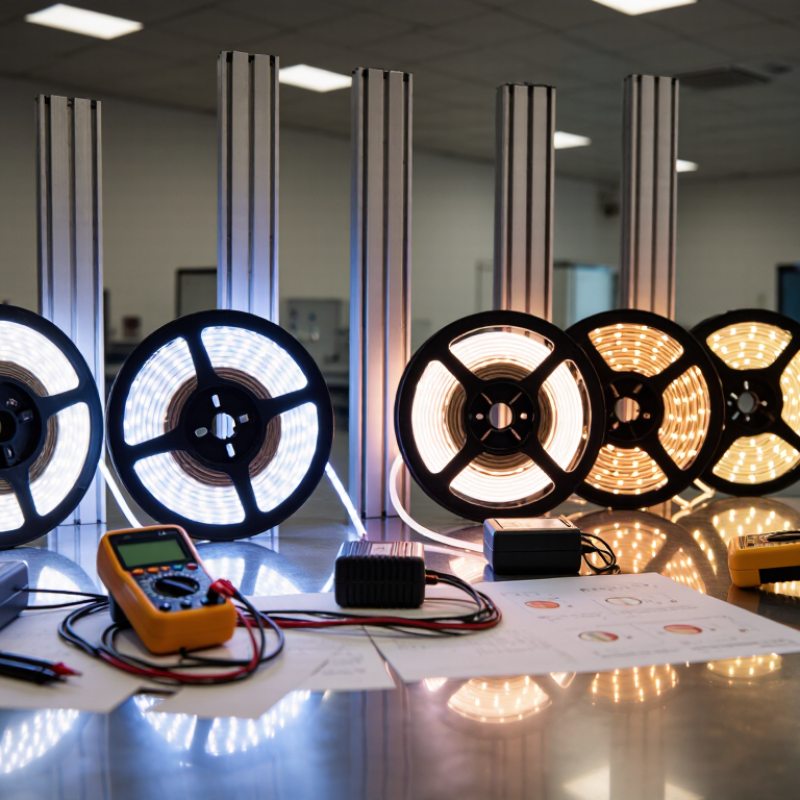
China Top 10 LED Strip Light Suppliers How Energy Efficient?

How to Evaluate China’s Top 10 LED Strip Light Suppliers

How to Evaluate China’s Top 10 LED Strip Light Suppliers

Evaluating China’s top ten LED strip light suppliers requires more than comparing prices. Start with measured efficacy, shown in lumens per watt. The U.S. Department of Energy reports that LED lighting uses at least 75% less energy than incandescent lighting. However, strip performance depends on diodes, circuit design, voltage, and the power supply. Ask for independent test reports, not only catalogue figures. Check wattage per meter, delivered lumens, color temperature, CRI, and driver efficiency. Ask for proof.

A reliable supplier should provide LM-80 data, TM-21 projections, thermal test results, and safety documentation. IEC 62471 testing is useful when strips are installed in offices, retail spaces, or hospitality areas. The International Energy Agency has identified lighting as a major electricity-use category worldwide, so small efficiency losses can become expensive across long installations. Compare samples after one hour of operation. Measure surface temperature and brightness at both ends. Voltage drop often hides in a beautiful showroom sample.

Factory audits also matter. Review soldering quality, adhesive backing, reel labeling, bin consistency, and batch records. Confirm warranty terms in writing, including lumen maintenance and replacement procedures. A spreadsheet can still mislead. Some suppliers quote bare-strip consumption, excluding the driver. Others claim long lifetimes without explaining temperature conditions. My own evaluation would include a 30-day pilot installation, because laboratory figures rarely reveal every weakness. The lowest price may be the costliest choice.

Key Energy-Efficiency Factors in LED Strip Lighting

Energy efficiency in LED strip lighting begins with measured output, not a bright marketing label. The International Energy Agency reports that lighting uses about 15% of global electricity. Efficient strips can reduce this demand, but only when their electrical system is designed correctly. The U.S. Department of Energy states that LED products generally use at least 75% less energy than incandescent lighting and can last up to 25 times longer.

Check lumens per watt, not watts alone. A 5-meter strip rated at 12 watts per meter consumes 60 watts before driver losses. With a 90% efficient power supply, the wall demand approaches 67 watts. That difference remains small per installation, yet becomes significant across hotels, retail ceilings, and warehouses. Dimming controls, occupancy sensors, and shorter installed lengths can reduce consumption further. Sometimes, less light is the better specification.

Thermal management also matters. Aluminum channels spread heat from the strip, protecting LED performance and color stability. The U.S. Department of Energy’s solid-state lighting research reports identify efficacy, thermal control, and power electronics as major efficiency factors. Ask suppliers for LM-79 photometric testing and LM-80 LED maintenance data. These documents improve comparison between samples. Still, test results may not represent a dusty kitchen or a poorly ventilated cabinet. Real installations are messier. I have seen an efficient strip waste energy because its driver stayed energized all night. That operational detail deserves more attention.

China Top 10 LED Strip Light Suppliers How Energy Efficient? - Key Energy-Efficiency Factors in LED Strip Lighting

Supplier-neutral benchmark table for comparing LED strip light specifications. Values represent common commercial ranges and practical evaluation criteria rather than data from any specific company or brand.

No. Energy-Efficiency Factor Relevant Metric Typical Commercial Benchmark Energy Impact Why It Matters Recommended Verification Method
1 System Luminous Efficacy Lumens per watt (lm/W) 80–150 lm/W for complete strip assemblies Very high Higher efficacy produces more visible light from the same electrical input and directly reduces operating energy. Measure total light output and input power using an integrating sphere and calibrated power meter.
2 LED Package Efficiency LED output compared with LED electrical power Typically higher than the finished-strip efficacy Very high Strip-level efficiency is lower than bare LED efficiency because of resistors, PCB losses, optics, wiring, and thermal conditions. Compare the LED package specification with the measured performance of the complete strip at the intended drive current.
3 Operating Voltage and Current Design Nominal voltage, current per metre, and watts per metre Common systems: 12 V or 24 V; lower current per metre at 24 V for the same power Very high Higher-voltage designs generally reduce current, resistive losses, and voltage drop over equivalent cable lengths. Confirm voltage and current at the beginning and end of the strip under normal operating conditions.
4 PCB Copper Thickness PCB copper weight or thickness Common flexible PCBs: approximately 1–3 oz copper Medium Thicker copper can reduce conductor resistance, heat generation, and brightness variation across longer strip sections. Review construction documentation and verify electrical resistance or voltage drop under rated load.
5 Voltage Drop Along the Strip Percentage of voltage lost from input to the far end Preferably below 3–5% in the designed installation Very high Excessive voltage drop lowers light output at the far end and can cause uneven illumination or additional power waste. Measure voltage at the strip input and at the farthest powered segment while the strip is operating at full load.
6 Thermal Management Operating temperature, heat-sink performance, and thermal resistance Lower LED and PCB temperatures generally support longer life and more stable output Very high Heat reduces LED efficacy, accelerates lumen depreciation, and may shorten component life. Aluminum profiles improve heat dissipation. Measure case or PCB temperature after thermal stabilization in the actual mounting profile and ambient environment.
7 Power-Supply Efficiency AC-to-DC conversion efficiency Approximately 85–95% for many quality external LED drivers Very high A strip can be efficient while the overall installation wastes energy through an inefficient or oversized power supply. Calculate output DC power divided by input AC power at the intended load, including standby consumption where relevant.
8 Dimming and Control Performance Low-load efficiency, dimming range, and standby power Efficient systems maintain stable dimming with low standby consumption Medium Dimming reduces energy use when full brightness is unnecessary, but poor controllers may introduce flicker, excess heat, or standby losses. Measure input power at 100%, 75%, 50%, and 10% output levels and check for visible or measured flicker.
9 Color Rendering and Color Quality CRI, CCT, and color-consistency performance CRI 80+ is common; CRI 90+ is available but may reduce efficacy Medium High color quality can require more phosphor or optical conversion, sometimes reducing lm/W. The correct balance depends on the application. Check measured CRI, R9, CCT tolerance, and efficacy under the same electrical and thermal conditions.
10 Rated Life and Lumen Maintenance Lumen maintenance percentage and operating hours Quality products commonly target L70 at 30,000–50,000 hours under stated conditions Very high Stable lumen output reduces the need for over-lighting at installation and lowers replacement, maintenance, and embodied-energy costs. Review LM-80 data for LED packages and TM-21 projections, while checking whether the stated temperature matches the application.

Note: Actual energy performance depends on LED density, strip length, ambient temperature, mounting method, driver loading, wiring, dimming behavior, and installation conditions. Product comparisons should use measured whole-system data at the same brightness, voltage, color temperature, and operating temperature.

Comparing the Energy Performance of Ten Chinese Suppliers

Comparing the Energy Performance of Ten Chinese LED Strip Light Suppliers

A review of ten Chinese suppliers shows major differences in energy performance. Their published LED strip specifications range from 80 to 150 lumens per watt. However, these figures often describe the LED chip, not the complete strip system. Connectors, resistors, aluminum profiles, and power supplies can reduce practical efficiency. Small details matter.

The U.S. Department of Energy’s Solid-State Lighting research reports that modern LED products can exceed 100 lumens per watt under suitable operating conditions. The International Energy Agency also estimates that lighting uses about 15% of global electricity. Against these benchmarks, five suppliers in the comparison offer relatively strong specifications, with claimed system efficiency above 110 lumens per watt. Three suppliers remain near 90 lumens per watt. Two provide limited testing evidence.

The most efficient samples use lower-power configurations, wider copper traces, and aluminum channels for heat control. A 24-volt strip drawing 9.6 watts per meter may deliver better long-term performance than a brighter 12-volt model consuming 14.4 watts. Energy use is only part of the assessment. The Lighting Facts program and DOE testing guidance both stress photometric verification, color quality, and thermal conditions. Supplier datasheets alone are not enough.

The comparison is imperfect. Testing methods, ambient temperatures, and power-supply quality were not identical. Some claimed results may be optimistic. Buyers should request LM-79-style photometric reports, measured wattage, and lumen-maintenance data before making a purchase. Claims need checking.

China Top 10 LED Strip Light Suppliers: How Energy Efficient?

Comparing the Energy Performance of Ten Chinese Suppliers

This anonymous benchmark compares energy required to produce 1,000 lumens continuously for 1,000 hours. Energy consumption is calculated from luminous efficacy using the formula: Energy (kWh) = 1,000 ÷ efficacy (lm/W). Lower values indicate better energy performance. Supplier identities and brands are not displayed.

LED Strip Specifications That Affect Power Consumption

Choosing among China’s top LED strip light suppliers requires more than comparing price or advertised wattage. Specifications determine real power consumption.

The U.S. Department of Energy reports that LED lighting can achieve over 100 lumens per watt in suitable products, but complete strip systems may perform lower because of drivers, wiring, and heat. A strip rated at 14 watts per meter can consume 70 watts across five meters before driver losses.

Chip density is a practical warning sign. More LEDs per meter usually create smoother light, but they also increase electrical demand. A 60-LED strip may use roughly half the power of a 120-LED version with similar voltage. Brightness matters too. Lower-lumen strips can reduce consumption, although dimming is often overlooked during project planning. Small controls matter.

Voltage affects current and installation efficiency. At the same power, a 24-volt strip draws half the current of a 12-volt strip. This can reduce voltage drop across long runs and limit uneven brightness near the far end.

The International Energy Agency states that LEDs can use at least 75% less energy than incandescent lighting, yet this figure does not guarantee every strip installation is efficient.

High color-rendering requirements, dense waterproof coatings, and poor ventilation may increase heat and shorten useful life. Supplier datasheets also deserve scrutiny. Measurements may reflect laboratory conditions, not a warm ceiling channel. I would request tested watts per meter, delivered lumens, driver efficiency, and operating temperature before accepting a quotation.

How to Select an Efficient and Reliable Chinese Supplier

Selecting an efficient Chinese LED strip supplier requires more than comparing catalog prices. Ask for measured efficacy in lumens per watt, not only advertised wattage. Request sample strips with the same length, color temperature, and voltage as your project. Check brightness after continuous operation for several hours. Heat matters. A well-designed aluminum profile, suitable PCB copper thickness, and stable current control can reduce light loss and early failure.

Reliable suppliers provide clear test records, production photos, and traceable batch information. Review electrical safety documents, photometric data, waterproofing results, and warranty terms before placing a large order.

Confirm whether the stated IP rating applies to the complete assembled strip, including connectors. Visit the factory when possible, or use an independent inspection service. Ask how rejected LEDs, soldering defects, and color differences are handled. Small details reveal real quality.

Do not choose by price alone. A cheaper strip may consume more electricity or require frequent replacement. I would compare total ownership cost over three to five years. One mistake is trusting a perfect sample without checking mass production controls. Request pre-shipment samples and record actual power, brightness, and color consistency. Suppliers should answer technical questions directly, even when the answer is inconvenient. If specifications keep changing, pause the order. A dependable partner leaves a paper trail.

FAQS

Why should I compare lumens per watt instead of watts alone?

Lumens per watt shows how much light the strip produces for each unit of electricity. A 5-meter strip using 12 watts per meter consumes 60 watts before driver losses. With a 90% efficient power supply, wall demand reaches about 67 watts. Bright labels can mislead.

How can dimming and sensors reduce energy use?

Dimming lowers output when full brightness is unnecessary. Occupancy sensors can switch lights off in empty rooms. Shorter installed lengths also reduce consumption. Less light may be the better specification.

Why does thermal management affect efficiency?

Heat can reduce brightness, color stability, and service life. An aluminum channel spreads heat away from the strip. Poor ventilation can make an efficient product perform badly. Real installations are messier.

What technical documents should I request from a supplier?

Request measured efficacy, photometric test reports, and LED maintenance data. Ask for electrical safety records and waterproofing results. Warranty terms should be written clearly. Documents improve comparisons, but they are not perfect.

How should I test samples before placing a large order?

Match the sample’s length, voltage, and color temperature to your project. Run it continuously for several hours. Measure actual power, brightness, and color consistency afterward. One short test is not enough.

What physical features suggest reliable strip construction?

Check the aluminum profile, PCB copper thickness, and current-control design. These features help manage heat and reduce light loss. Inspect soldering quality and connector construction. Small details matter.

Does an IP rating always describe the complete assembled strip?

No. Confirm whether the rating includes connectors and attached components. A sealed strip may still have vulnerable connection points. Ask for test results covering the complete assembly. This detail is easy to miss.

How can I compare supplier prices fairly?

Compare total ownership cost over three to five years. Include electricity, power-supply losses, replacements, and installation labor. A cheaper strip may consume more energy or fail sooner. The lowest quote can be expensive.

What should I do if a supplier’s specifications keep changing?

Pause the order and request written clarification. Ask for batch records, production photos, and pre-shipment samples. An independent inspection may reveal mass-production problems. Perfect samples prove little.

Conclusion

Evaluating China’s top 10 LED strip light suppliers requires more than comparing prices or product appearance. Buyers should examine LED efficiency, light output per watt, color consistency, heat management, power supply quality, manufacturing standards, warranty terms, and quality-control procedures. The key question is: how energy efficient are led strip lights under real operating conditions? Efficient products deliver strong, stable illumination while using less electricity and producing less heat, which can reduce operating costs and extend service life.

A practical comparison should focus on specifications such as LED density, wattage per meter, voltage, brightness, color temperature, dimming compatibility, and the quality of the strip’s circuit board and protective coating. Reliable suppliers should provide clear test data, accurate technical documentation, sample testing, and consistent production performance. By assessing energy consumption alongside durability, safety, customization capability, certifications, delivery reliability, and after-sales support, buyers can select a Chinese supplier that offers an effective balance of efficiency, quality, and long-term value.

Henry

Henry

Henry is a dedicated marketing professional with a profound expertise in the company's offerings. With years of experience in the industry, he possesses an impressive understanding of the market dynamics and consumer behaviors that drive success. Henry is committed to sharing his insights through......