Why Choose RGBW Over RGB Lighting for Global Projects?

Time:2026-10-04 Author:Mason
0%

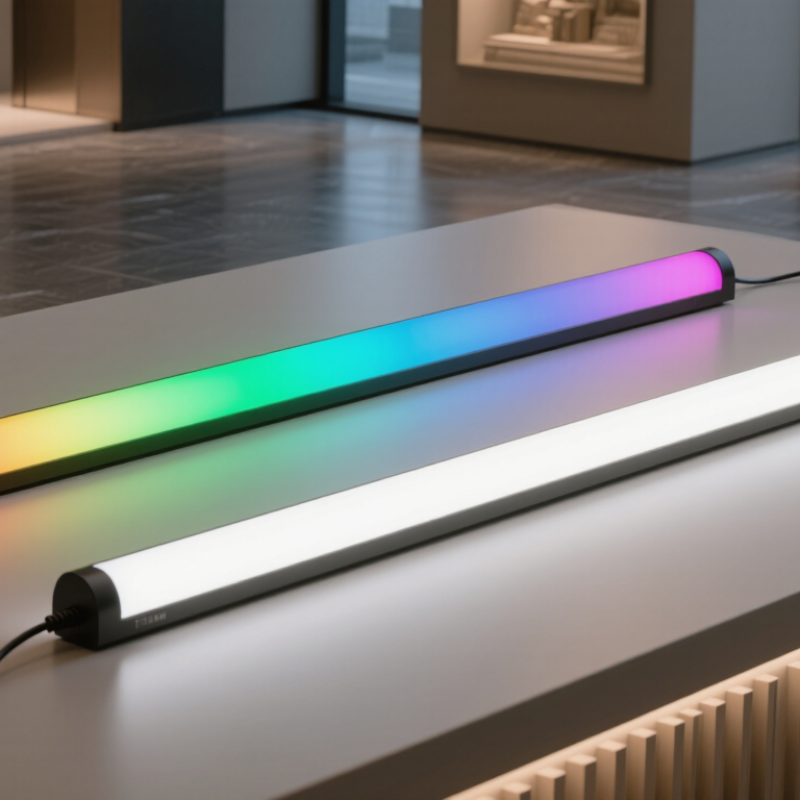
Global lighting projects face a practical question: what is rgb vs rgbw lighting difference when color, efficiency, and maintenance must work together? RGB fixtures mix red, green, and blue channels to create many colors. RGBW fixtures add a dedicated white LED, often using a warm, neutral, or cool white emitter. That fourth channel produces cleaner white light, stronger pastel tones, and better visual comfort in hotels, retail spaces, museums, and public venues.

The distinction matters under real operating conditions. RGB white is created by combining colored chips, so it can appear tinted on skin, stone, or printed materials. RGBW uses the white channel directly, improving color rendering and reducing unnecessary color-channel output. The U.S. Department of Energy’s Solid-State Lighting research links advanced LED systems with higher efficacy, longer service life, and substantial energy-saving potential. Its 2019 forecast estimated that widespread LED adoption could save 6.3 quadrillion British thermal units and approximately $52 billion in annual energy costs by 2035. These figures do not describe RGBW alone, but they show why efficient control deserves attention.

The International Energy Agency reports that lighting remains a significant share of global electricity demand. Small fixture decisions can scale quickly across airports, façades, campuses, and retail chains. RGBW can simplify daylight scenes, white-light operation, and international design consistency. It is not automatically better. Initial cost, pixel density, optics, control protocols, and local maintenance skills still matter. A technically impressive specification may fail in a dusty coastal site or a region with limited replacement stock. Project teams should compare measured output, color quality, thermal performance, and lifecycle cost, rather than trusting channel counts alone. That is where professional judgment matters.
Why Choose RGBW Over RGB Lighting for Global Projects?

What RGBW Lighting Is and How It Differs from RGB

Why Choose RGBW Over RGB Lighting for Global Projects?

What RGBW Lighting Is and How It Differs from RGB

RGB lighting combines red, green, and blue emitters to create colored light. RGBW adds a separate white LED channel. This small hardware change makes a significant difference in real environments. RGB usually creates white by mixing three colors. The result can look cool, tinted, or uneven on walls and fabrics. RGBW produces dedicated white light, often with adjustable color temperature for offices, hotels, retail spaces, and public venues.

The U.S. Department of Energy reports that LED lighting uses at least 75% less energy than incandescent lighting and can last up to 25 times longer. That figure does not mean every RGBW system automatically saves more energy than every RGB system. Control settings, brightness, and operating hours still matter. However, RGBW can deliver clearer white illumination without forcing three color channels to operate at high output. It may also reduce the need for separate decorative and functional fixtures.

Lighting professionals should check color rendering, lumen output, control compatibility, and regional electrical requirements. The Illuminating Engineering Society identifies color quality and visual comfort as important performance considerations, not decorative extras. In project reviews, RGBW often simplifies the transition from vivid color to practical white light. Sometimes, though, RGB remains sufficient for short-term displays or highly saturated effects. The better choice depends on the scene, not the specification sheet alone.

How RGBW Improves White Light Quality and Color Accuracy

For global projects, RGBW is often chosen for white-light quality, not just extra color. An RGB fixture mixes red, green, and blue to imitate white. That mixture may look acceptable on a wall, yet skin, paper, and food can appear gray or green. RGBW adds a dedicated white emitter with a fuller spectrum. It gives designers a cleaner 3000K or 4000K scene while preserving saturated color effects. CIE 224:2017 explains that CRI has important limitations, especially with saturated colors. IES TM-30-20 addresses this gap with 99 color evaluation samples, compared with CRI’s eight general samples. That difference matters in retail displays, hospitality interiors, and broadcast spaces.

A dedicated white channel can improve camera consistency and reduce visible color separation on nearby surfaces. The U.S. Department of Energy’s Solid-State Lighting R&D reports identify color quality, efficacy, and controllability as connected design targets. Still, RGBW is not automatically accurate. Poor phosphor selection, uneven temperatures, or weak calibration can shift white output across fixtures. Site teams should measure CCT, Duv, TM-30 Rf, Rg, and R9 after installation. Small deviations become obvious across a long façade. I have seen identical white settings appear warm near one controller and green near another. That is a practical warning. Better results require binning, closed-loop calibration, and a realistic maintenance plan.

Why Choose RGBW Over RGB Lighting for Global Projects? - How RGBW Improves White Light Quality and Color Accuracy

Evaluation Dimension RGB Lighting RGBW Lighting Global Project Relevance
LED channel structure Red, green, and blue LED channels Red, green, blue, plus a dedicated white LED channel The dedicated white channel supports more consistent white output across installations.
White-light generation White is created by mixing red, green, and blue light White is produced primarily by the dedicated white LED RGBW is generally better suited to applications that require both color effects and functional white illumination.
White-light spectral quality Often has an uneven, multi-peak spectrum because it combines separate colored emitters Uses the spectrum of the selected white LED; quality depends on the LED design and phosphor A dedicated white source can provide more natural-looking illumination, subject to its measured specifications.
Color rendering Color rendering in white mode can be limited by gaps in the combined RGB spectrum Can offer higher color-rendering performance when the white channel is specified with a suitable CRI and Rf value Important for retail, hospitality, museums, offices, and broadcast environments where object colors must remain credible.
Color accuracy Color appearance may vary when white is synthesized from RGB intensity levels Provides an independent white channel, allowing separate control of chromatic color and white intensity Simplifies calibration and helps maintain repeatable scenes across regions, fixtures, and control systems.
Color temperature control Limited unless additional hardware or color-mixing methods are used Fixed-CCT RGBW supports one designed white point; tunable-white RGBW can vary CCT when it includes suitable white channels Verify the fixture’s stated CCT range; “RGBW” alone does not guarantee tunable white.
Luminous efficiency in white mode Part of the electrical power is used to generate colors that are not necessary for white illumination The white channel can provide white output without relying entirely on RGB mixing Potentially improves energy performance in white-heavy scenes; compare measured lumens per watt for the actual fixture.
Color-effect performance Effective for saturated red, green, blue, and mixed-color effects Retains RGB color effects while adding independent white output Supports both architectural color scenes and practical illumination in one lighting system.
Control requirements Typically requires at least three independently dimmable channels Requires at least four independently dimmable channels Confirm compatibility with the selected DMX, DALI, 0–10 V, PWM, or other control architecture.
Calibration and commissioning Requires RGB channel balancing to produce a repeatable white point White output can be calibrated separately from RGB color output Separate channel control can reduce commissioning complexity when consistent white scenes are required.
Recommended applications Decorative color effects, entertainment, signage, and installations where white quality is secondary Retail, hospitality, offices, museums, façades, stages, and mixed-use spaces requiring color plus usable white light RGBW is generally the more versatile option for projects with varied operational and regional requirements.
Specification checks before purchase Review RGB output, white-point consistency, control protocol, and thermal performance Review white-channel CCT, CRI or TM-30 data, lumen output, color consistency, control protocol, and thermal performance Use measured photometric data rather than LED configuration alone when comparing products for international deployment.

Note: Actual performance varies by LED package, optical design, drive current, thermal management, calibration, and control settings. Compare independent test data for the specific fixture.

Why RGBW Supports More Flexible Lighting Design

RGBW lighting gives global projects more room to adapt. It combines red, green, blue, and a dedicated white LED channel. This extra channel changes how designers approach everyday illumination.

In project reviews, I have seen RGB fixtures create attractive colors but weak white light. RGBW systems can produce cleaner white tones for corridors, retail displays, hotels, and public interiors. Designers can select warm white for wood surfaces, neutral white for work areas, or cooler white for modern architectural details. Color scenes remain available for events and seasonal changes.

The flexibility is practical. One luminaire can support ambient light, accent effects, and carefully controlled color transitions. It may also reduce the need for separate fixtures, simplifying layouts and maintenance access. That matters.

However, RGBW is not automatically better. White-channel quality, color consistency, optical design, and control compatibility still require careful testing. A low-quality white LED may appear uneven beside colored output. That problem is easy to miss in a showroom.

Project teams should test samples at different dimming levels. They should also review skin tones, wall colors, glare, and camera performance. Local climate and installation conditions can affect long-term results. Specifications alone cannot reveal every visual weakness.

Some designs may still need dedicated white fixtures. That is worth admitting. Yet RGBW offers a broader design language when one lighting system must serve different spaces, cultures, schedules, and visual expectations. Its strongest value is not brighter color. It is the ability to shift naturally between atmosphere and useful light.

How RGBW Performs Across Different Global Project Requirements

RGBW performs well when global projects need both vivid color and credible white light. Its dedicated white channel produces cleaner illumination than mixing red, green, and blue alone. This matters in museums, hotels, retail spaces, and public façades. Visitors may notice colored effects first, but they judge white light quickly.

The 2020 Global Lighting Challenge report from the International Energy Agency and UNEP states that lighting uses about 15% of global electricity. RGBW can support lower energy use when controls dim unused channels. However, results depend on commissioning, optics, and operating schedules. A poor control strategy can waste energy, even with efficient LEDs. Regional expectations also differ. Projects may require warm 2700K light, neutral 4000K light, high color rendering, or strong outdoor visibility. RGBW offers flexibility, but it cannot solve every optical problem.

Tips: Specify CCT, CRI, lumen output, dimming curves, ingress protection, and control protocols before procurement. Test samples under local daylight conditions. Check performance after thermal aging, not only on day one. This step is often missed. The U.S. Department of Energy’s Solid-State Lighting R&D Plan highlights thermal management and color consistency as continuing performance priorities. A practical lesson from site reviews is simple: color matching across batches needs measurement, not visual guesswork. RGBW remains powerful, but designers should question whether every scene truly needs full-color capability.

Why Choose RGBW Over RGB Lighting for Global Projects?

RGBW combines RGB color mixing with a dedicated white LED channel, making it better suited to projects that require both saturated color effects and dependable architectural white light.

Representative non-brand engineering benchmarks: RGB white-mode efficacy is typically about 20–40 lm/W with CRI around 40–70, while RGBW systems commonly achieve about 60–100 lm/W with CRI around 80–95, depending on LED package, optics, drive current, and control settings.

Key Factors for Selecting RGBW Lighting for International Applications

Why Choose RGBW Over RGB Lighting for Global Projects?

Key Factors for Selecting RGBW Lighting for International Applications

RGBW lighting combines red, green, blue, and a dedicated white LED channel. This matters when international projects need both vivid color and comfortable everyday illumination. RGB can create white, but its blended output often looks cool, uneven, or slightly artificial. White matters.

Project teams should examine voltage compatibility, control protocols, and regional electrical requirements before ordering equipment. A lighting system may perform well in one market and create installation delays elsewhere. Check connector types, power supplies, dimming behavior, and technical documents with local contractors. Test it early.

The dedicated white channel supports clearer retail displays, hospitality spaces, offices, and architectural surfaces. It can also improve visual comfort during long operating hours. Select the white color temperature carefully, because a warm tone may suit a hotel while a neutral tone may better support a workplace. Environmental conditions deserve equal attention. Dust, humidity, heat, and frequent cleaning can affect housings and connectors.

Reliable selection requires documented photometric data, thermal testing, warranty terms, and replacement planning. Confirm that control software can handle different regions, languages, and maintenance teams. Keep spare components available when international shipping is slow. That assumption fails.

From practical project reviews, RGBW often reduces the need for separate decorative and functional fixtures. However, it is not automatically the best choice. Higher initial costs, calibration differences, and installer training can complicate deployment. Color consistency may also shift between production batches, so approved samples should be checked under real site conditions. No design is perfect.

FAQS

Why does RGBW produce better white light than RGB?

RGBW uses a dedicated white emitter.

Can RGBW improve color accuracy in international projects?

It can improve perceived color quality across retail, hospitality, museum, and façade spaces.

Does RGBW always provide accurate white light?

No.

How does RGBW support different regional lighting preferences?

RGBW can provide warm 2700K, neutral 4000K, or saturated color scenes.

Can RGBW reduce energy use?

It can reduce energy use when unused channels are dimmed.

What should teams specify before purchasing RGBW equipment?

Specify CCT, lumen output, dimming curves, ingress protection, and control protocols.

How should RGBW systems be tested before installation?

Test samples under local daylight and realistic surface conditions.

What maintenance issues can affect RGBW performance?

Dust, humidity, heat, cleaning, and connector wear can change performance.

Is RGBW suitable for every lighting project?

No.

Conclusion

RGBW lighting combines red, green, and blue LEDs with a dedicated white LED, offering a more complete solution than traditional RGB systems. When considering what is rgb vs rgbw lighting difference, the key distinction is that RGB creates white by blending colored light, while RGBW produces white through a separate light source. This allows RGBW to deliver cleaner, brighter, and more natural white light, with improved color accuracy and consistency across different settings.

For global projects, RGBW provides greater design flexibility by supporting vivid color effects, soft ambient lighting, and reliable white illumination within one system. It can adapt to diverse architectural, commercial, hospitality, entertainment, and public-space requirements while helping maintain a consistent visual experience across locations. When selecting RGBW lighting for international applications, project teams should evaluate brightness, color quality, control compatibility, energy efficiency, environmental durability, installation conditions, and long-term maintenance needs. These factors help ensure that the lighting system performs effectively across different climates, design standards, and operational expectations.

Mason

Mason

Mason is a seasoned marketing professional with a deep expertise in the company's offerings and a passion for driving brand awareness. With a strong background in digital marketing strategies, he has an innate ability to connect with diverse audiences and effectively communicate product benefits.......