Halo Light
Halo Light
Halo Light
High-performance silicone co-extrusion, COB dot-free arrays, and intelligent digital control modules optimized for architectural and commercial implementations.
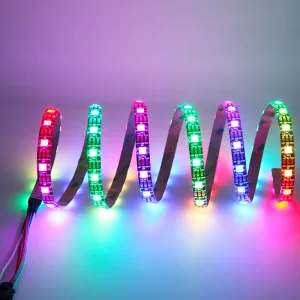
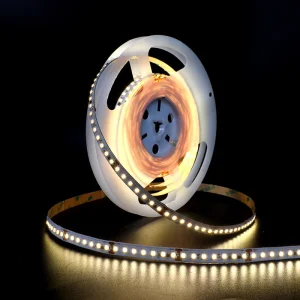
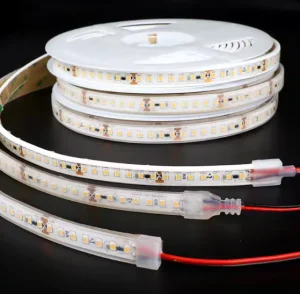
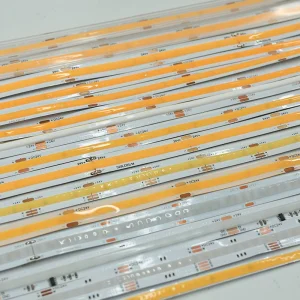
Pioneering precision manufacturing, rigorous testing protocols, and vertically integrated LED systems designed for global distribution.
Hangzhou Halo Light Co., Ltd. has steadily evolved into a competitive, premium LED strip light manufacturer, specializing in advanced Neon Flex, SMD, and COB LED lighting solutions for global markets. Since its establishment, the company has focused on combining innovation, quality manufacturing, and customer-oriented service to meet the growing demand for energy-efficient and flexible lighting systems.
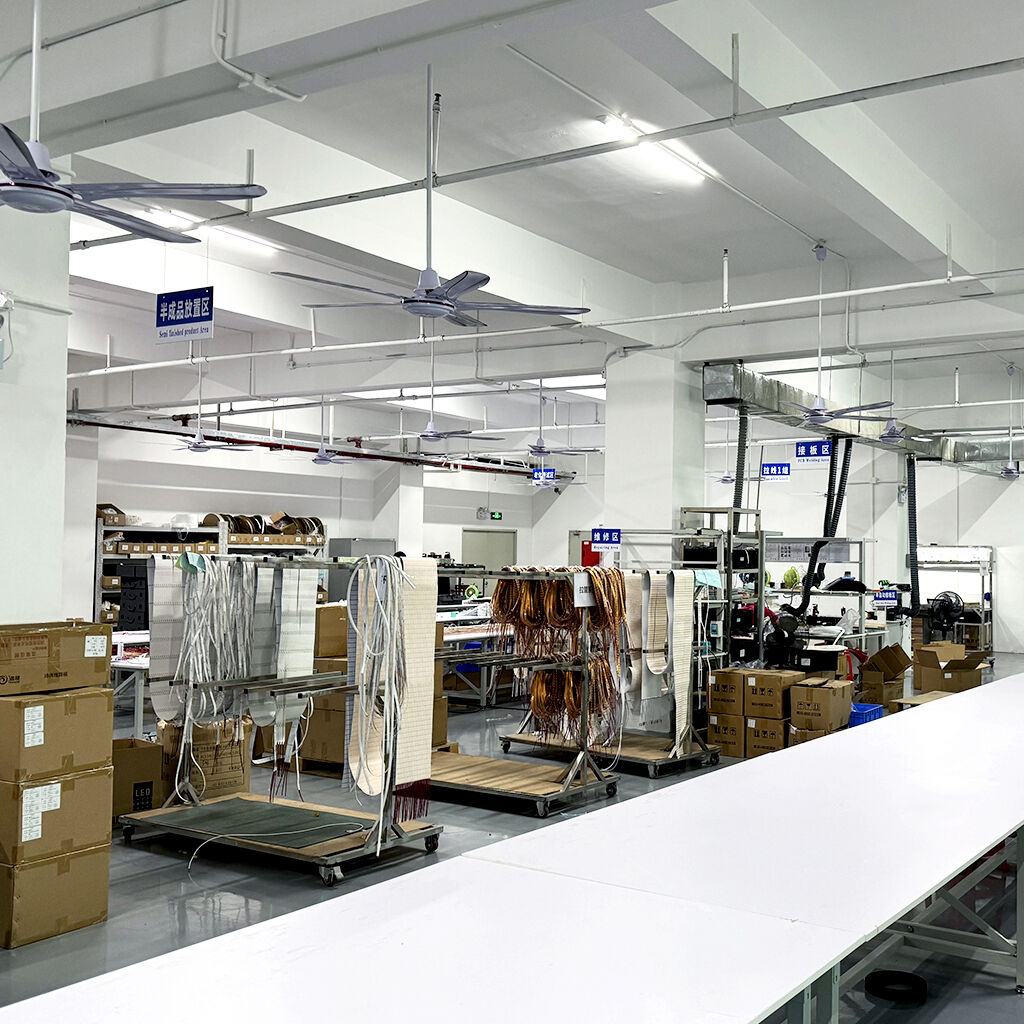
Based in Hangzhou, a key center for technology and manufacturing in China, Halo Light operates a modern production facility equipped with automated assembly lines and strict quality control processes. Over the years, the company has built a professional team of engineers and technicians dedicated to continuous product development and performance optimization.
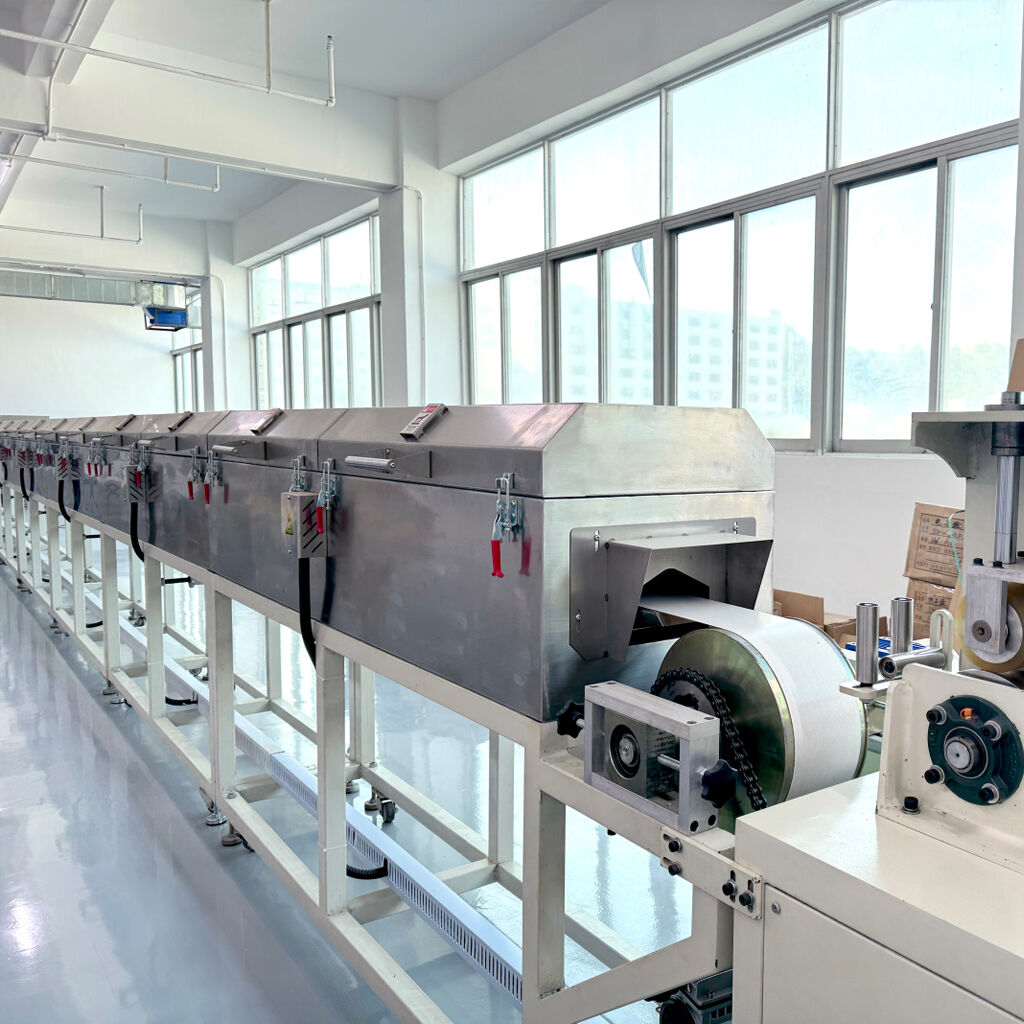
With a strong emphasis on research and development, Hangzhou Halo Light has expanded its product range from standard LED strip lights to high-density COB strips, durable Neon Flex solutions, and intelligent lighting systems suitable for architectural, commercial, and residential applications. Its products are widely recognized for their stability, brightness consistency, and long service life.
Driven by global market trends and sustainable development goals, the company continues to enhance its manufacturing capabilities and expand its international presence, aiming to deliver reliable, efficient, and innovative LED lighting solutions worldwide. Through strict compliance with ISO9001 and extensive third-party product testing, the facility maintains zero-defect engineering standards.
Understanding the shifts in the commercial lighting sector and the accelerating demand for high-end flexible fixtures.
The global commercial lighting landscape is undergoing a structural transition. Architectural specifications are moving away from rigid fixtures in favor of seamless, customizable linear solutions. Modern flexible light bars—incorporating technologies like Chip-on-Board (COB) arrays and specialized silicone co-extrusion—have evolved from simple backlighting accents to principal illumination sources.
Currently, the industrial sector relies heavily on flexible light bars for critical applications, including automation visual systems, heavy machinery, hazardous industrial plants, marine vessels, and extensive infrastructure outlines. The transition from PVC-based casings to food-grade organic silicone has significantly improved durability, enabling installations to withstand severe weather, marine salinity, extreme UV rays, and fluctuating ambient temperatures.
In terms of market distribution, North American and European markets demand high-efficiency products complying with stringent safety certifications like ETL, UL, and CE. Simultaneously, developing infrastructure hubs in the Middle East and Southeast Asia are integrating large-scale, DMX512-controlled flexible RGB and pixel strip lights into landmark architecture. Consequently, partnering with top-tier Chinese manufacturing operations that support robust OEM/ODM pipelines is a key strategic advantage for global procurement agents.
Exploring the technical innovations driving the next generation of flexible linear LED modules.
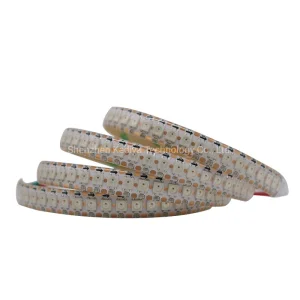
Traditional SMD strips require thick diffusers to eliminate individual LED hot spots. Chip-on-Board (COB) technology embeds the chips directly onto the flexible PCB substrate under a continuous phosphor coating. This design provides 180-degree uniform light output and ultra-high densities up to 896 LEDs per meter, eliminating pixelation in shallow aluminum profiles.
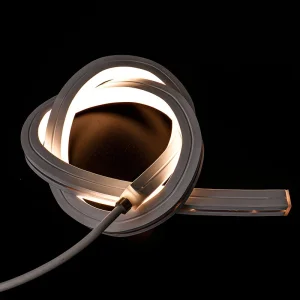
By switching from PVC to organic liquid silicone, modern extrusions achieve exceptional anti-UV performance, resistance to salt-water corrosion, and thermal stability. The material retains its flexibility at sub-zero temperatures and does not yellow over time, making it the industry standard for architectural and marine installations.
Standard flexible strips experience voltage drop, which leads to reduced brightness at the far end of the run. Integrated Constant Current (CC) micro-IC drivers stabilize current levels along the entire run (up to 15-20 meters with a single power feed). This layout maintains consistent lux output and chromaticity coordinates across the entire installation.
Customizable engineering systems designed to meet complex spatial and performance criteria.
Exterior installations demand high ingress protection and resistance to structural movement. Using IP67/IP68 3D-bending silicone neon profiles combined with intelligent DMX512 pixel control systems allows designers to create dynamic light shows across building envelopes. The silicone casing protects components from thermal contraction, wind load shear, and UV exposure.
Luxury retail, galleries, and high-end hospitality projects require accurate color reproduction (CRI > 95, TM-30 Rf > 92). Utilizing high-density COB strips with custom CCT (Correlated Color Temperature) tuning between 2700K and 6500K ensures surfaces look natural. The dot-free light emission eliminates harsh reflections on polished floors or countertops.
Saltwater accelerates the degradation of standard copper PCBs and causes yellowing in PVC light casings. Specifying anti-salt spray, UV-stabilized silicone flexible light bars prevents chemical corrosion. Sealed, injection-molded IP67/IP68 connections protect critical wiring points, maintaining long-term reliability in marine and coastal areas.
Industrial machinery cabinets and control rooms require compact, low-heat lighting. 5V and 12V low-voltage COB or ultra-slim 2835 SMD strip lights fit into tight spaces. Operating on Class 2 SELV (Safety Extra Low Voltage) systems reduces electrical hazards, and the low thermal output extends the operational life of adjacent industrial controls.
Answers to critical technical questions from engineering, procurement, and architectural specialists.
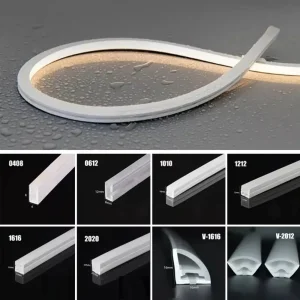
Additional commercial products, ranging from ultra-thin silicone profiles to programmable DMX and high-density COB lighting solutions.